
Update: This blog post was written right before Bill 32 was passed and updated right after before being published. Now that Bill 32 has passed, the changes in the "After" section are in effect.
On November 25th, 2025 the government introduced Bill 32 to amend the Mental Health Act, which passed in the legislature on December 2nd. There has been significant debate and confusion about the impact of the bill, so Health Justice has written this post to try to help people with lived and living experience understand what it means for them.
Before Bill 32: Consent
The ability to control what happens to our own bodies, including by consenting or refusing health care, is a fundamental human right. The health care consent rights of all adults in BC are set out in the Health Care (Consent) and Care Facility (Admission) Act. These rights include:
Being presumed capable of consenting or refusing health care unless you are assessed as incapable.
If you are capable, the right to consent or refuse health care, even if it results in death.
If you are incapable, the right to have your wishes and preferences respected in decisions about your health care though tools like:
Representation agreements, where you chose in advance who you trust to make health care decisions for you
Advanced directives, where you choose what treatment you do and do not consent to in specific situations (you make these decisions when you are capable to be used if/when you are ever incapable)
Temporary substitute decision makers, where the law appoints someone close to you (a spouse, child, parent, sibling, etc.) or the Public Guardian and Trustee if you don’t have someone who can fill this role
The Health Care (Consent) and Care Facility (Admission) Act also has exceptions for emergencies and other situations when health care can be provided.
Before Bill 32, all involuntary patients under the Mental Health Act were exempt from all the protections in the Health Care (Consent) and Care Facility (Admission) Act related to “psychiatric care or treatment.” Instead, their consent rights for that health care are “carved out” and covered by the Mental Health Act.
Graphic that shows how before Bill 32, all involuntary patients under the Mental Health Act were exempt from all the protections in the Health Care (Consent) and Care Facility (Admission) Act related to “psychiatric care or treatment” because consent rights for that health care are “carved out” and covered by the Mental Health Act.
For involuntary patients under the Mental Health Act, it was commonly understood that section 31(1) of the Act authorized psychiatric treatment. That section says “treatment authorized by the director is deemed to be given with the consent of the patient.” This meant they had no choice and were deemed to consent to all psychiatric treatment authorized by the “Director,” who is a person appointed under the Act to be in charge of a designated facility, or someone they designate.
The important part is that people experiencing involuntary treatment:
do not get the rights in the Health Care (Consent) and Care Facility (Admission) Act, AND
have no legal way of having their wishes and values, or people they choose and trust to know their wishes and values, involved in treatment decisions.
Before Bill 32: Treatment
Section 31(1) of the Act has been understood to authorized involuntary “treatment,” which is defined under the Act as meaning “safe and effective psychiatric treatment and includes any procedure necessarily related to the provision of psychiatric treatment.” Health care that does not fall within this definition of treatment has been understood to be provided via the Health Care (Consent) and Care Facility (Admission) Act. Treatment under the Mental Health Act is recorded in Form 5: Consent to Treatment, a legally required form that documents either patient consent to treatment or the Director’s authorization of treatment.
After Bill 32: Does it change how the Mental Health Act deals with consent?
Bill 32 repeals section 31(1) from the Mental Health Act. This means the section that says “treatment authorized by the director is deemed to be given with the consent of the patient” will be removed from the Act.
So, the words “deemed consent” will no longer be in the law in BC. But what change does this have in practice?
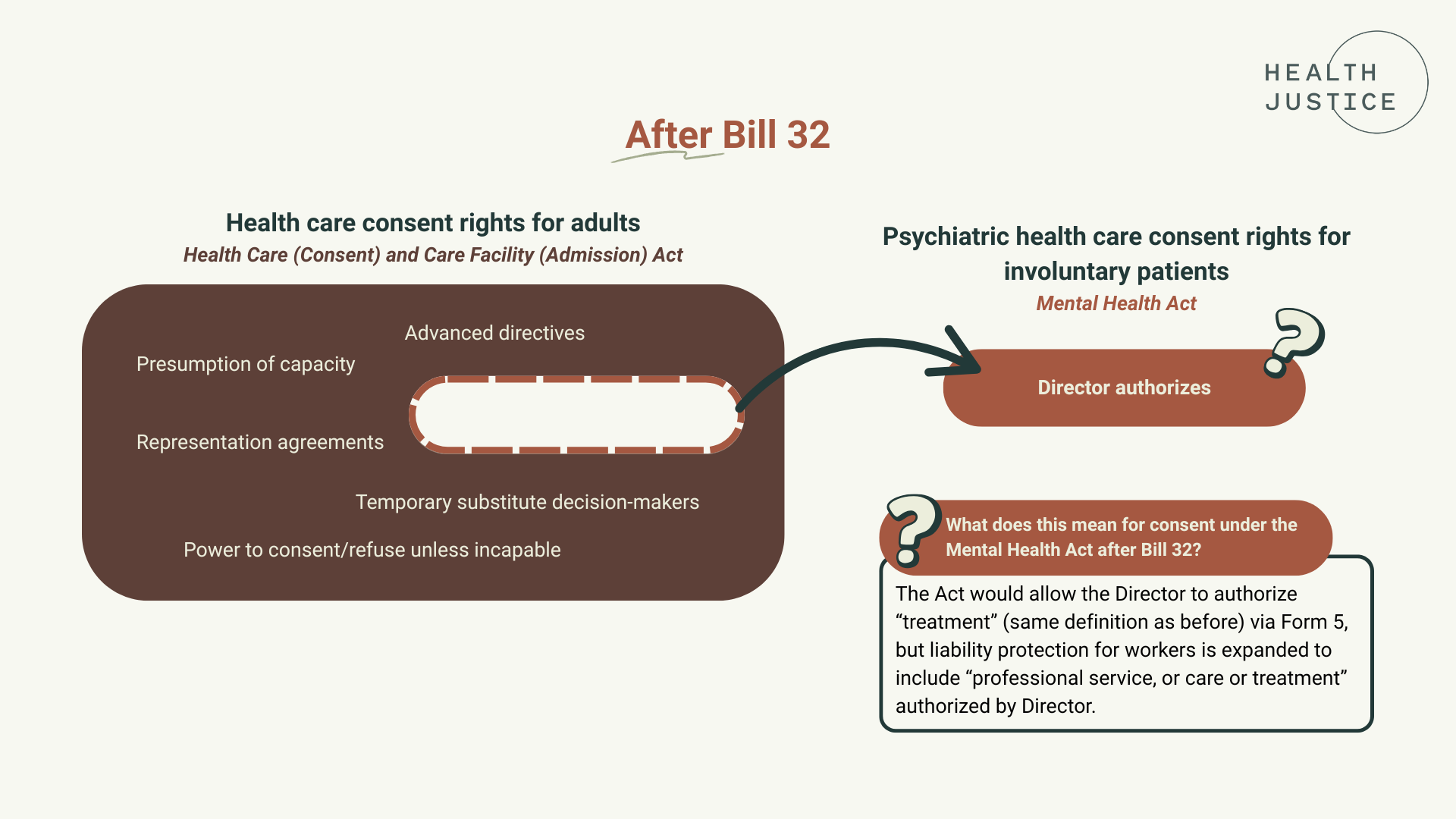

The first image is “After Bill 32”, a visual that shows how after Bill 32, all involuntary patients under the Mental Health Act are still exempt from all the protections in the Health Care (Consent) and Care Facility (Admission) Act related to “psychiatric care or treatment” because consent rights for that health care are “carved out” and covered by the Mental Health Act through Director authorization. The second Image is “Before Bill 32”, a visual that shows how before Bill 32, all involuntary patients under the Mental Health Act were exempt from all the protections in the Health Care (Consent) and Care Facility (Admission) Act related to “psychiatric care or treatment” because consent rights for that health care are “carved out” and covered by the Mental Health Act. Select the images to see them in larger view.
At first glance, very little changes to health care consent rights for people experiencing involuntary psychiatric treatment under the Mental Health Act. They are still “carved out” from the health care consent rights granted to all other adults under the Health Care (Consent) and Care Facility (Admission) Act. Bill 32 does not change that. It also does not include any additions to the Act that would ensure that their wishes and values, or people they choose and trust to know their wishes and values, are legally required to be included in treatment decisions.
The primary change is that the Mental Health Act will now clearly say that health care workers are only permitted to provide involuntary health care if it is authorized by the Director, “including treatment described in a consent to treatment form.” This last part refers to Form 5. We will talk more about the impact of this below.
What are the responsibilities of a Director when authorizing treatment?
BC’s Standards for Operators & Directors of Designated Mental Health Facilities provide clarity on the responsibilities of a Director when authorizing treatment. They say:
Before authorizing treatment based on the Form 5, the director shall ensure that the description of the treatment proposed by the physician:
Is of sufficient detail, and specifically that the physician has set out the nature of the patient’s mental health diagnosis, nature of the condition, , options for treatment, the reasons for and the likely benefits and risks of the proposed treatment for the patient.
Is sufficiently descriptive: for example, it includes details of medication class and behavioural therapy type (it is not necessary to list individual medications).
Constitutes psychiatric treatment only and does not purport to authorize treatment for which consent of the patient, or their substitute decision maker, is required under the Health Care (Consent) and Care Facility (Admission) Act.
Does not purport to authorize treatment for a patient who has not been involuntarily admitted in accordance with the Mental Health Act.
Describes the specific patient’s proposed course of treatment in plain language, specific to the actual treatment required by the particular patient, and is set out in legible printing or handwriting.
That the physician who has completed the form has not use rubber stamps, generic or “boilerplate” language which is not specific to the circumstances of the patient.
The Standards go on to require that the Director must follow this process for each Form 5 and that a Form 5 should be completed:
As soon as possible upon the involuntary admission of the patient and not more than 24 hours after the director has involuntary admitted the patient to the designated facility.
Each time there is a significant change in treatment, which was not contemplated in a prior Form 5 and specifically where there is a change in the patient’s diagnosis which requires a different treatment plan.
But what if Form 5s are not completed?
Bill 32 provides liability protection for staff providing a patient a professional service, care or treatment authorized by the Director under the Act, including through completing a Form 5. This leaves open that a Director may be able to authorize involuntary services, care or treatment in other ways beyond Form 5.
However, staff will need a formal way to document a Director’s authorization so they are protected from liability. Any authorization from a Director should meet the requirements set out in the Standards of Operations (listed above) regardless of whether it is provided via Form 5.
Failure to properly document a Director’s authorization for involuntary treatment has been an ongoing issue under the Mental Health Act. The Ombudsperson’s office has found that, even though it is legally required, there are many instances where Form 5 is not completed at all or not completed adequately. For example, in the Ombudsperson’s last update, Fraser Health Authority did not have properly completed Form 5s in 90% of patient files.
Graph above pulled from “Systemic Investigation Update: Report on the Implementation of Recommendations from COMMITTED TO CHANGE: Protecting the Rights of Involuntary Patients under the Mental Health Act” showing the percentage of patient files containing Form 5 (Consent for Treatment) versus percentage with fully completed Form 5, by health authority, Oct - Dec 2020. The graph shows a low rate of properly completed Form 5s in patient files.
This means that, in cases where a Form 5 is not on a person’s file or it is not properly completed before involuntary treatment is administered, the health care workers who actually administer the treatment may be subject to liability unless the Director’s authorization can be demonstrated in another way. So when Bill 32 is in force, it is crucial for the Ministry of Health to develop monitoring and oversight to ensure that Form 5s are being completed adequately and that Directors are meeting their responsibilities when authorizing treatment.
Do the amendments expand involuntary treatment?
This is hard to answer because the Minister of Health has been clear in her comments in the legislature that it is not the government’s intention to expand involuntary treatment through Bill 32. The exemptions from the Health Care (Consent) and Care Facility (Admission) Act are still the same: they are limited to psychiatric care or treatment.
However, another reading of the Bill is that staff are now protected from the involuntary administration of not just “treatment”, but also “professional services” and “care.” Those terms are not defined in the Bill or in the Act, so it is unclear what those mean or if they fall outside of involuntary “psychiatric care and treatment” exempt from the Health Care (Consent) and Care Facility (Admission) Act. This is likely a source of significant confusion and uncertainty.
Does it address the Charter challenge currently before the BC Supreme Court?
The Minister of Health has also been clear in her comments in the legislature that the government does not believe Bill 32 will defeat or resolve the legal challenge brought by the Council of Canadians with Disabilities asserting that the consent regime in the Mental Health Act violates the Charter of Rights and Freedoms. It will ultimately be up to the parties and the judge hearing the case to determine how Bill 32 will impact the case.
What’s next?
While Bill 32 does not make any significant changes to the health care consent rights of involuntary patients under the Mental Health Act, it may create confusion and fear among health care workers about how the changes impact their work and their liability. It may also create uncertainty about how it intersects with the Health Care (Consent) and Care Facility (Admission) Act.
At a minimum, existing provincial guidance on the Mental Health Act will need to be revised, including documents like:
the Guide to the Mental Health Act,
guidance from the Chief Scientific Advisor on Psychiatry, Toxic Drugs, and Concurrent Disorders,
the Emergency Mental Health Education Manual, and others.
These documents rely partially or entirely on section 31(1) of the Mental Health Act for providing involuntary treatment. If that section of the Act is repealed under Bill 32, then they will be outdated and inaccurate. This may cause significant confusion.
The work continues
Most importantly, nothing in Bill 32 adds any legal requirement to consider the wishes, values, and views of a person experiencing involuntary treatment. It also does not provide any legal requirement to include family members or the people a patient trusts to make decision if they are not able to do so.
As well, we are not aware of any engagement with people with lived and living experience in the development of Bill 32. The work to strengthen the rights of people who experience involuntary treatment and include their perspectives in their own health care continues. We urge BC to support an in-depth, proactive, and independent review of the Mental Health Act to ensure that occurs.