
Radical change required: A roadmap for treatment under the Mental Health Act
Text in graphic blocks along the left that reads “Radical change required: A roadmap for treatment under the Mental Health Act. The BC Supreme Court’s decision highlights that discriminatory stereotypes have formed the foundation of the Mental Health Act. The law must be radically amended.” To the right of the text is an image of a person with long hair, wearing a jacket. They are facing away, walking across a crosswalk in a city.
Calls for sweeping increases in involuntary treatment focus narrowly on locking people in detention facilities away from public eye, with little attention paid to what happens next. Although these calls are framed as an act of “compassion”, they completely overlook how profoundly a person’s wellbeing and human rights are affected by the laws, procedures, and institutional culture that shape how involuntary treatment is actually experienced and how treatment decisions are actually made.
Once someone is detained under the Mental Health Act, what happens behind hospital doors matters.
People with lived and living experience of involuntary treatment, community organizations, and independent investigations into the involuntary treatment system have warned that BC’s approach behind those closed doors is archaic, discriminatory, and harmful to many of the very people the law is intended to help. These warnings were largely ignored or dismissed as anti-treatment, anti-psychiatry, or unfounded.
That changed in July 2026, when the BC Supreme Court found that BC’s approach to involuntary treatment violated sections 7 and 15 of the Canadian Charter of Rights and Freedoms. The decision not only affirms longstanding concerns raised by affected communities. It also documented in stark detail the nature and extent of the harm caused by BC’s approach.
In summary, it argued that BC’s approach violated the Charter because involuntary treatment is administered regardless of whether a person is capable of consenting or refusing that treatment, treatment directive made while a person is capable have no legal force for involuntary patients, and involuntary patients have no right to have the people who know them act as substitute decision-makers if they are not able to make their own decisions. Instead, the treatment team and detaining facility hold all decision-making power, also referred to as “deemed consent.”
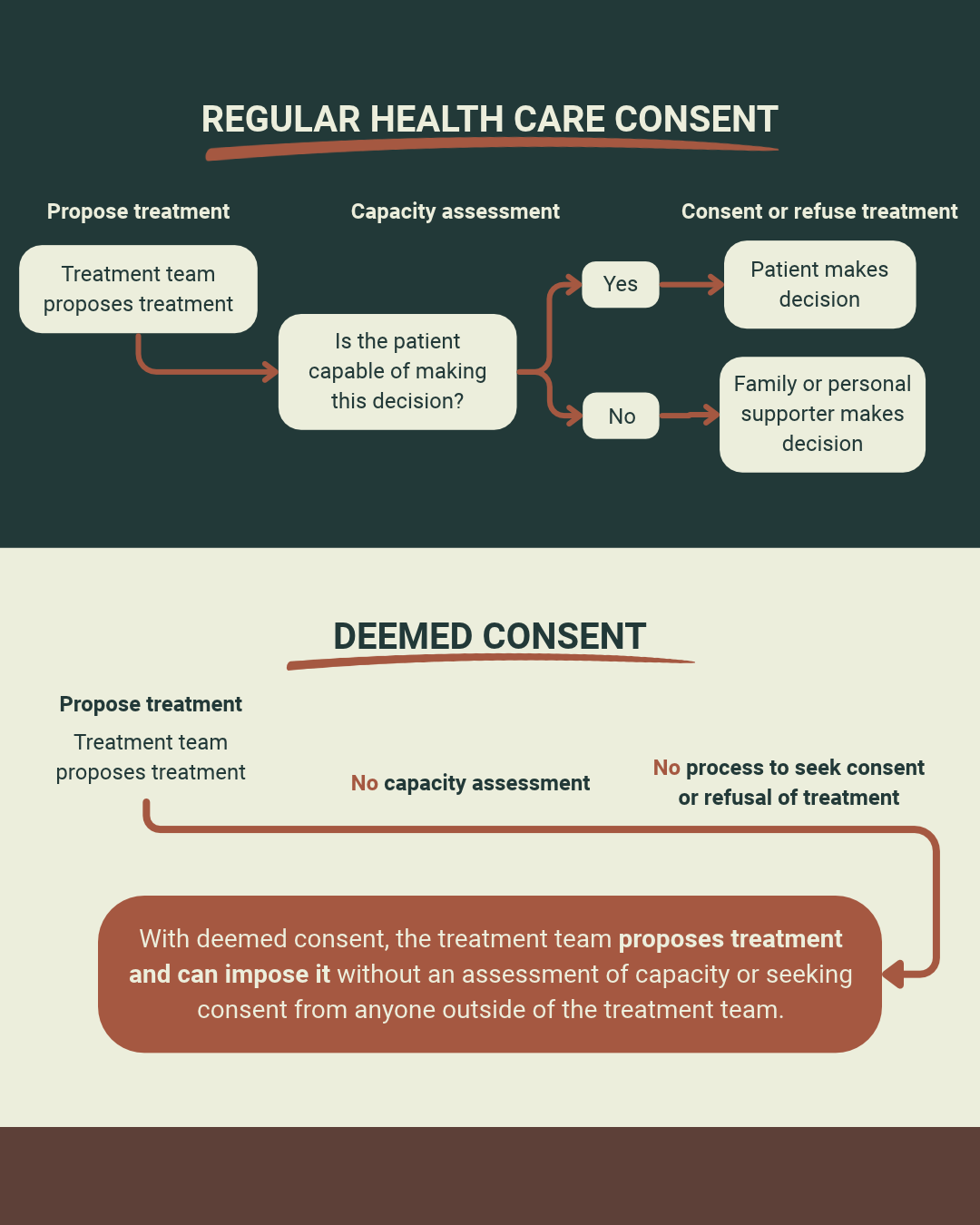
Flow chart that shows the differences in the path of regular health care consent versus deemed consent.
After 34 days of trial, this is what the Court said about sections of the law that govern how involuntary treatment is delivered in BC:
They lead to patients experiencing “serious violence in the manner in which psychiatric treatment is administered, including restraint by multiple security guards, being placed in seclusion, being stripped of clothing, and being forcibly injected with mind-altering, antipsychotic medication.”[1]
They may be experienced as “abusive, humiliating, punitive and stigmatizing” and lead to patients “experiencing feelings of powerlessness, fear, mistrust, disempowerment, distress, helplessness, desperation, shame, degradation, rage, fear, sadness, loneliness, aggression, and disorientation.”[2]
As a whole, the deemed consent laws:
“completely eviscerate health care consent rights for involuntarily admitted patients”[3]
“Perpetuate the stereotype that individuals with mental disabilities lack the capacity to make informed decisions about their treatment”;[4]
“Reinforce, perpetuate, and exacerbate the longstanding marginalization and social exclusion of individuals with mental disabilities”[5]
The Court gave BC six months to amend the law to fix the Charter violations outlined in the decision. After six months, the Deemed Consent Laws will no longer have any force or authority unless BC applies to the Court and is granted an extension.
A roadmap for treatment under the Mental Health Act
Below is a roadmap that BC can follow to amend the Mental Health Act and create a consent and treatment approach that complies with the Charter, the Court’s findings, and best practices.
-
BC amended the Mental Health Act to provide the same rights that apply to all other forms of healthcare, but is also tailored for the specific needs of people detained under the Act. BC should not just default to the same laws applying to everyone.
A specialized approach will ensure that the Mental Health Act:
refutes entrenched stereotypes that people with mental disabilities are less capable or less deserving of bodily autonomy.
provides a unified approach that can apply to children, youth, and adults.
allows for individualized assessments that meet the specific needs of people with mental disabilities.
-
The BC Supreme Court was clear: “Outside of emergency situations, physicians do not, and cannot, make medical decisions on behalf of a patient in any other area in health care, notwithstanding their medical expertise.”[6]
To provide meaningful informed consent, the patient, their representative, or a substitute decision-maker must consent or refuse treatment before it can be provided. This approach is used in all other healthcare in BC.
-
Regardless of their capacity and who holds legal decision-making authority, all patients should have a statutory protected right to participate in decision about their treatment.
Participation improves treatment outcomes. The Court found that the 14 experts who testified “agreed that involving patients in treatment decisions improves the therapeutic alliance, treatment adherence, clinical outcomes, satisfaction, and quality of life.”[7]
-
Until the contrary is demonstrated, every patient is presumed to be capable of giving, refusing or revoking consent to treatment. This mirrors the law that applies to all other healthcare.
There is a heightened need for a clear presumption of capacity under the Mental Health Act because people with mental disabilities are subject to entrenched, longstanding, discriminatory stereotypes about their capacity and their ability to participate in decisions that impact their lives.
-
If healthcare workers have concerns about a person’s capacity to make a treatment decision, they must carry out a capacity assessment. This should be separate from the decision to detain a person to ensure a meaningful and independent assessment.
The law must set out specific factors that are considered in a capacity assessment, as well as specific factors that cannot on their own be used to find someone incapable. For example, a person’s disagreement with the proposed treatment does not mean someone is incapable.
Research shows that capacity assessments are often influenced by racial or cultural bias. A rigorous and standardized capacity assessment tool must be used to minimize bias and racism.
Assessments must be completed by an independent health professional with specialized training, documented in writing in a detailed legal form, and those forms should be subject to auditing and oversight.
-
Capable patients should not be treated without their consent with the exception of emergency powers. This standard matches the consent rights enjoyed by all other areas of healthcare.
The law must require a form that documents consent to treatment, including explanation of all aspects of informed consent, and signed by the patient. It must be subject to auditing and oversight.
If there is any legal authority for a physician to treat a capable patient without their consent must require approval; from an independent tribunal or authority. The process should require a high bar to refute the entrenched stereotypes that people with mental disabilities are less capable.
-
Prior treatment decisions and directives made when a person is capable must be legally valid and respected under the Mental Health Act. The Court was clear that this is required for the Act to be constitutional.
Any appointment of a representative in a Representation Agreement made while capable must be legally valid and respected under the Mental Health Act. The Court was clear that this is required for the Act to be constitutional.
Evidence is clear that respecting a patient’s preferences and prior experience, and involving family and friends in decision-making will support better treatment outcomes.
-
If a patient is incapable of making a treatment decision and has no advanced directives or formally appointed representative, the law must require consent from a substitute decision-maker.
This approach ensures that whenever possible, consent is required from someone who knows the patient, their wishes and values, and are willing to act in their best interests.
Whenever possible, the patient must be given an opportunity to select a substitute decision-maker. This approach is used in Nunavut and Northwest Territories and would result in faster identification of a substitute decision-maker and less conflict.
-
Representatives and substitute decision-makers must have strict legal duties to comply with instructions the person expressed while capable, consult with the individual as much as possible, and act in the individual’s best interests.
“Best Interests” should be defined in the Mental Health Act to meet the specific needs of people with mental disabilities. At a minimum, “best interests” must include all of the risks and benefits of a proposed treatment, including how it is delivered, and consider:
the person’s current wishes, culture, traditions, and known beliefs and values,
whether the person condition or well-being (as defined by them) is likely to be improved by the proposed treatment,
whether the person’s condition or well-being (as defined by them) is likely to improve without the proposed treatment,
whether the benefit the person is expected to obtain from the proposed treatment is greater than the risk of harm, and
whether a less restrictive or less intrusive option other the proposed treatment is available.
-
If a detaining facility does not have consent to administer treatment, any treatment should be limited to emergency treatment.
The Mental Health Act should provide a definition of emergency treatment that is more detailed, specific and clear than the one in the general provision that applies to all other healthcare.
This is required to support change management in BC’s mental health system, which has been operating without a need to seek any informed consent for treatment decisions for decades. Without it, emergency powers will likely be overused.
Any emergency treatment must be documented in a form subject to auditing and oversight, including what emergency treatment was administered, why the situation met the threshold for an emergency. What de-escalation attempts were made, and plans to end the emergency treatment if it is ongoing. Forms must be completed at specific intervals, every 4-6 hours, if the emergency treatment is ongoing.
A rotten foundation requires radical change
The recent political focus on increasing involuntary treatment frames it as an act of “compassion,” but that rings hollow when no attention is paid to how it is delivered. The BC Supreme Court’s decision highlights that discriminatory stereotypes have formed the foundation of the Mental Health Act, resulting in immense harm and human rights violations. It emphasizes that the system has been built on a rotten foundation. People with lived and living experience have been clear: to provide truly compassionate services BC must radically amend the law to combat those stereotypes, comply with the Charter, and begin the long road of change.
Sources
Council of Canadians with Disabilities v British Columbia (Attorney General), 2026 BCSC 1416 Para. 864
Para. 539
Para. 866
Para. 965
Para. 949
Para. 977
Para. 528
Did you find this interesting? Share this post using the buttons below!