
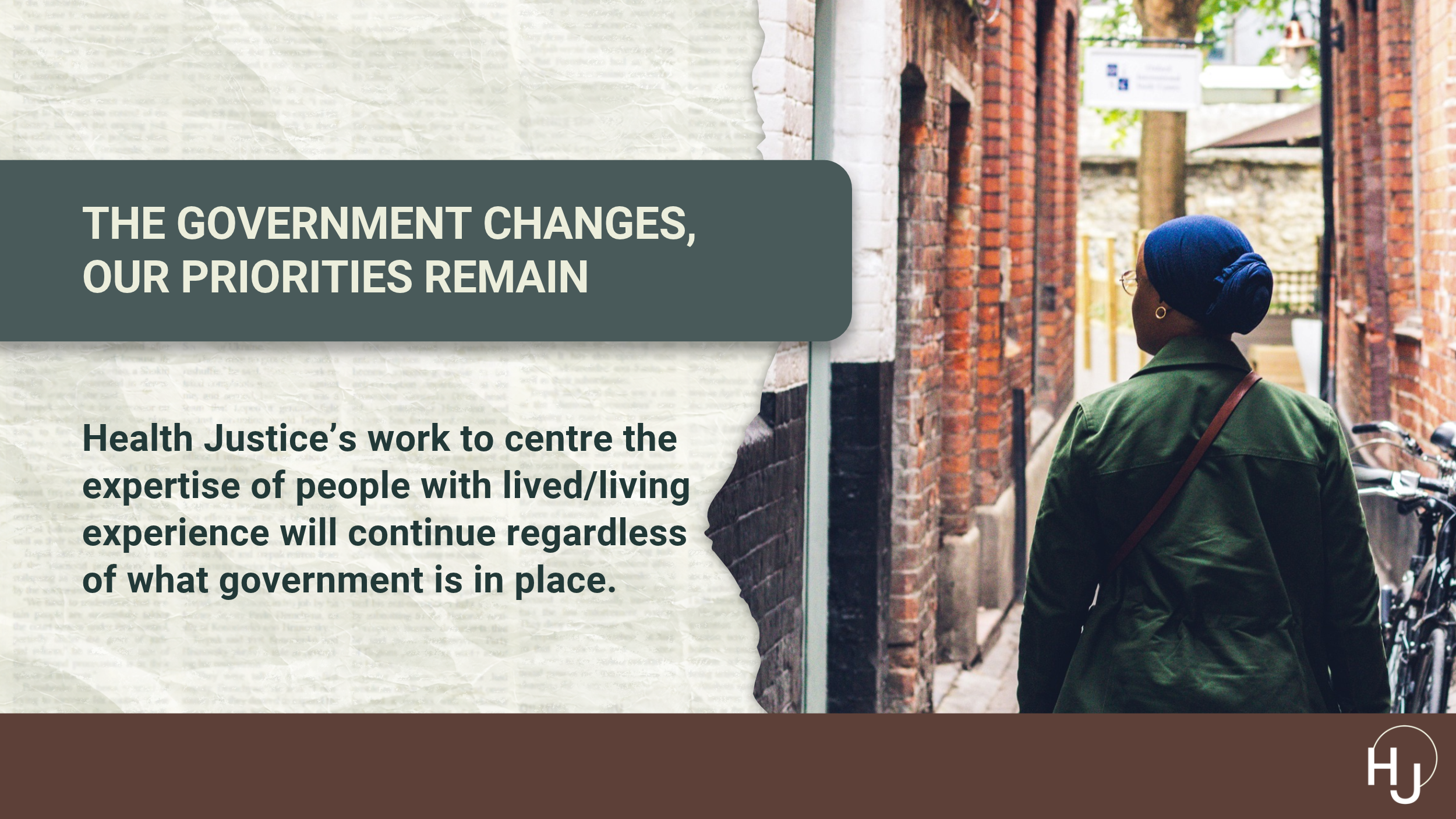
Text in graphic blocks along the left that reads “The government changes, our priorities remain. Health Justice’s work to centre the expertise of people with lived/living experience will continue regardless of what government is in place.” To the right of the text is an image of a woman in a headwrap and jacket walking away down an alley, with either side of the alley framing her.
This week BC’s new MLAs and Cabinet Ministers will be sworn in to form the newly elected government. There’s a lot we don’t know about the new government’s priorities and plans, but the election results have led to fear and concern in community about the future. We know that many communities have been the focus of discriminatory attacks as local, provincial, national, and global politics have become increasingly divisive and extreme. The impact of this on marginalized communities can’t be ignored. While we sit with the fears and concern in community, we also want to be clear that Health Justice’s work to centre the expertise of people with lived/living experience will continue regardless of what government is in place.
So, what’s our next steps?
Here are three priorities for this work in the coming months:
An independent review of the Mental Health Act. The new government committed to an independent review of the Act in their party’s platform and a review was previously announced by the former Premier. BC’s Mental Health Act is archaic, outdated, and unique in the world in its failure to respect human rights. There have also been countless reports and recommendations documenting the problems with the current system and calling for change.
Health Justice will ensure that government follows through on this commitment and advocating for the Framework for a review of the Mental Health Act. The Framework is based on engagement with the Lived Experience Experts Group, Indigenous Leadership Group, as well as external partners. We also researched mental health law review processes used by other provinces and countries. The Framework offers a roadmap for an effective and meaningful review that that will result in real positive change for people impacted by the law.
Abolishing deemed consent and complying with the Charter. In July 2026, the BC Supreme Court found that the deemed consent approach in the Mental Health Act (the parts of the law that allow treatment teams to make all decisions with no requirements for consent from the patient or their substitute decision-makers) violate two sections of the Charter of Rights and Freedoms. The Court’s decision confirmed what people with lived and living experience have been saying for decades: BC’s approach to involuntary treatment violates human rights.
The new government has until the end of January to fix the human rights violations the Court identified. They can apply for more time to do that work, but the work still must be done. Health Justice will call for the government to change the law to align with our Road Map for Radical Change, a plan for a consent and treatment approach that complies with the Charter, the Court’s findings, and evidence-based best practices.
Improved transparency and accountability. The new government’s platform included a commitment to improve the healthcare system by “publish[ing] clear information about access and outcomes so you can judge what works and what doesn’t.” This commitment to improved transparency and accountability is desperately needed in relation to involuntary mental health and substance use treatment.
BC’s Mental Health Act has some of the weakest oversight and accountability safeguards in Canada – for example, BC is the only province or territory in Canada that has no form of automatic review of detention built into its mental health law. Data is not collected about some of the most basic exercises of legal authority. There are no accountability consequences for detaining facilities that violate legal requirements. There is no independent office that provides consistent and proactive monitoring of detaining facilities. Health Justice will continue to advocate for best practices in oversight and accountability, and specifically the five types of oversight and accountability that should be included in all mental health systems.
A new government and the continued fight for mental health rights
A change in government comes with concern and uncertainty, especially in the wake of a divisive and chaotic election. As we learn who will make up the Cabinet of the new government, as well as more hints about the new government’s priorities, Health Justice will continue to advocate for a mental health and substance use system that respects human rights and supports wellness.
Did you find this interesting? Share this post using the buttons below!